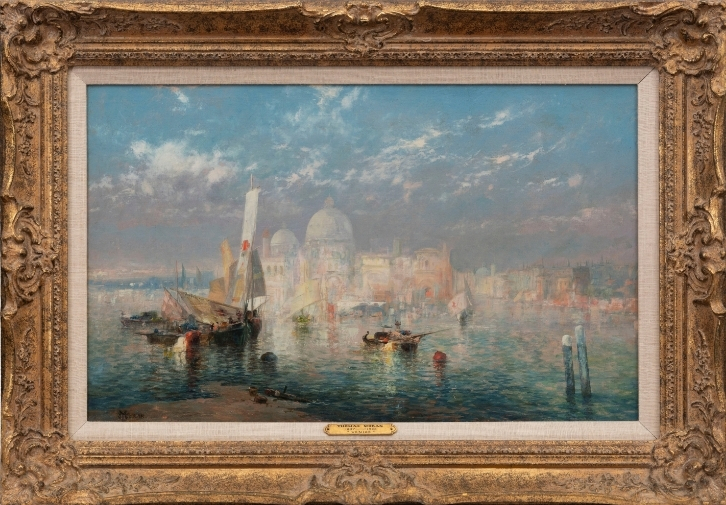
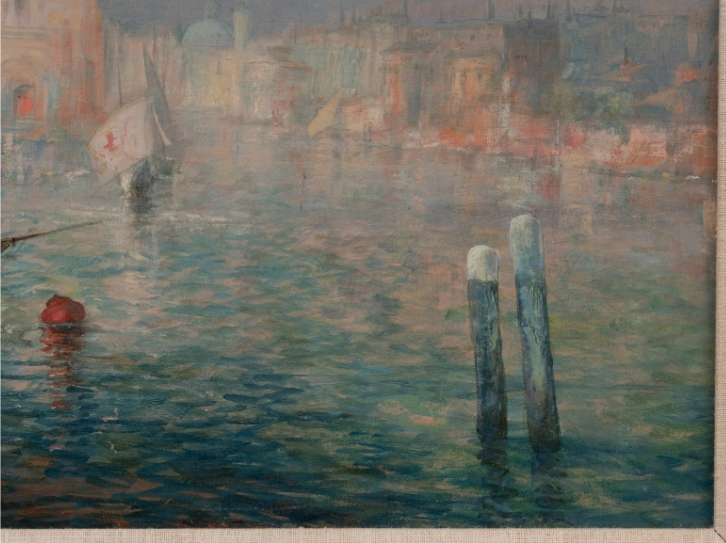
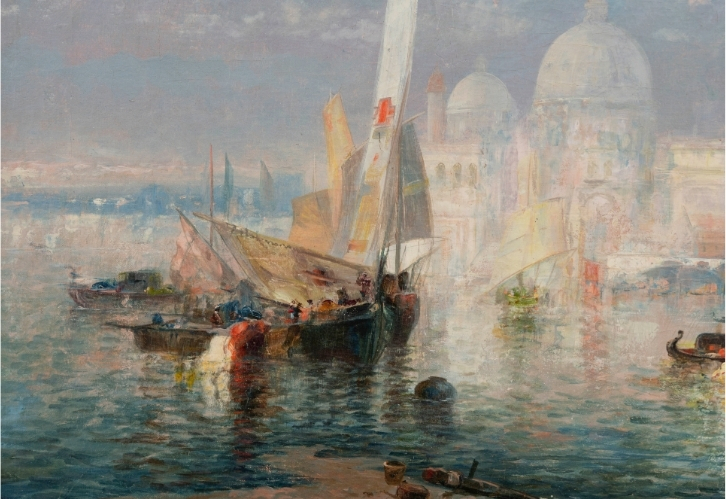
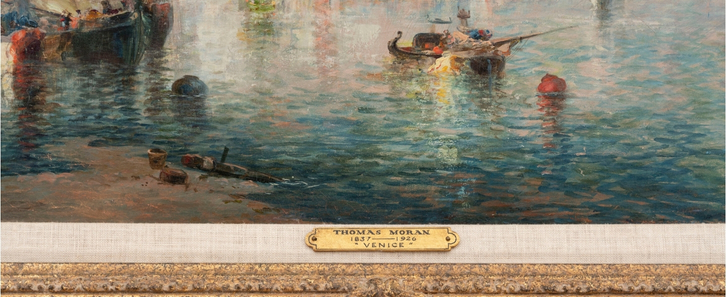
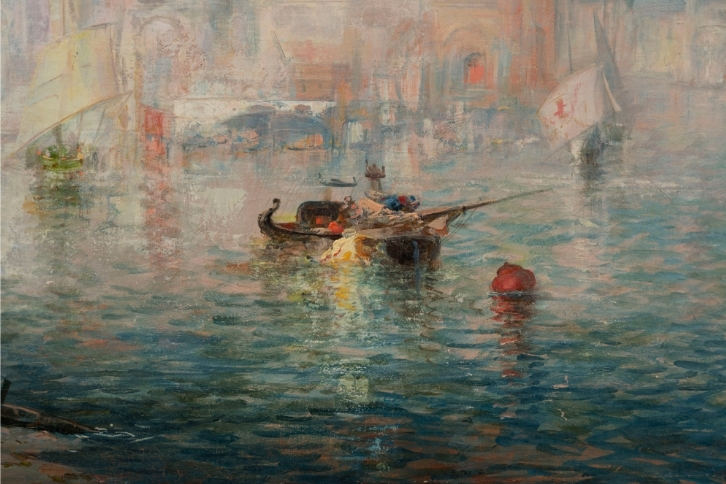
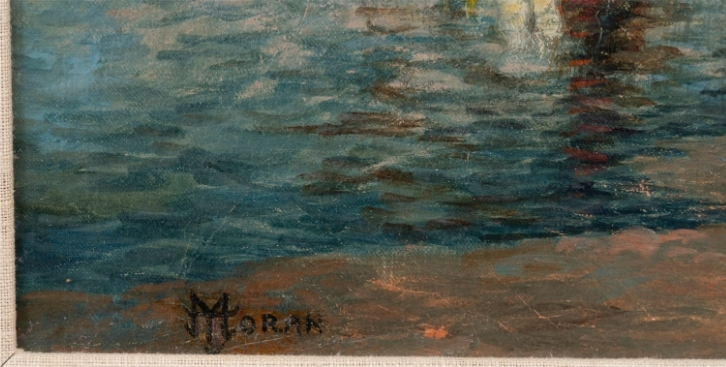
Venice by Thomas Moran (1837-1926), oil on canvas, 15 1/2″ x 25 3/4″, signed lower left.
A leading figure of the Hudson River School, Thomas Moran is best known for his sweeping landscapes of the American West. These sublime panoramas secured his prominence as one of nineteenth-century America’s foremost painters, while also shaping the nation’s visual imagination. Moran’s vision, however, extended well beyond the Western frontier. Among his less frequently studied but deeply accomplished works is a series of Venetian scenes, where he applied his Romantic sensibility to the city’s luminous canals, ornate architecture, and singular light. Venice exemplifies this mastery.
Moran visited Venice three times—first in 1886, and again in 1890 and 1911—and painted this work following one of the trips. The composition centers on Santa Maria della Salute, the seventeenth century Roman Catholic basilica at the junction of the Grand Canal and the Giudecca. From this architectural focal point, the scene unfolds through light and color rather than line, demonstrating Moran’s command of atmosphere as subtle gradations of blue and gold merge sky and water into a continuous field of light. In the foreground, more deliberate brushwork defines the rippling water and moored boats, anchoring the composition in material specificity. Through this balance of tonal unity and descriptive precision, Moran reinterprets a well-known Venetian subject as a study in light, space, and painterly technique.
The subject of Venice held enduring fascination for Moran, and he returned to it repeatedly, producing several works—many simply titled Venice—that now reside in major American collections. The Venice of 1887, in the Pennsylvania Academy of the Fine Arts, offers a more subdued vision of the city, its darkened lagoon reflecting a misty view of San Giorgio Maggiore, the sixteenth-century Benedictine church with its classical dome and slender campanile. By contrast, the Venice of 1904, now in the Cleveland Museum of Art, centers again on Santa Maria della Salute, its domes framed by elegant sailboats and set aglow in the fiery hues of a setting sun.
Moran’s engagement deepened with A View of Venice from 1891—now owned by the Smithsonian American Art Museum—where he takes greater artistic liberty, fusing several of the city’s most iconic landmarks—the Palazzo Ducale, the Campanile di San Marco, and Santa Maria della Salute—into a single panoramic composition. Such a perspective would be impossible in reality, yet Moran synthesizes these sites into a dreamlike whole that conveys Venice’s transcendent allure. “Venice is all, and more, than travellers have reported of it,” he wrote to his wife in 1886. “It is wonderful.”
Among those “travellers” whose visions of Venice most profoundly shaped Moran’s own was J. M. W. Turner, the towering British landscape painter. Turner visited the city several times between 1819 and the 1830s, drawn to its shifting light, reflective waters, and theatrical architecture. He often rearranged its spatial logic to heighten emotional and visual effect, privileging atmosphere over accuracy. Turner’s Venetian paintings offered Moran a model for compositional freedom and luminous intensity, lessons fully realized in A View of Venice.
Turner’s influence radiated across Moran’s generation, many of whom turned to Venice as a laboratory for artistic experimentation. James McNeill Whistler and John Singer Sargent, for instance, each approached the city through their own sensibilities: Whistler’s Nocturnes distilled its architecture into subtle tonal harmonies of light and shadow, while Sargent captured its vitality through fluid brushwork and acute observation of social life along its canals. Like Moran, they saw Venice as both a subject and a symbol—a place where careful observation met creative imagination, and where the balance between light and structure shaped their artistic choices.
This shared artistic vision did not go unnoticed by contemporary critics. A New York Times review of an 1897 watercolor exhibition observed that “of the three Venetian scenes by Thomas Moran, little can be said beyond the usual praise of their Turneresque color and conception.” The comparison—by then shorthand for luminous virtuosity—placed Moran’s Venetian subjects within a transatlantic continuum of Romanticism and painterly sophistication. Such remarks also illuminate their appeal to collectors; the very qualities deemed “Turneresque”—radiant color, atmospheric depth, and evocative mood—were those that sustained the works’ critical and commercial success.
Indeed, Moran’s Venetian paintings were widely admired and highly marketable in his lifetime, quickly becoming among his most sought-after subjects. In 1886, sixty of his works—including several Venetian views—were exhibited at Ortgies Gallery prior to auction, signaling both critical interest and collector demand. The following year, two Venetian paintings appeared in the National Academy’s Annual Exhibition, and thereafter Moran contributed a Venetian subject to nearly every Academy show in which he participated. By the late 1890s, his Venetian scenes also hung in C. W. Kraushaar’s galleries, confirming their enduring popular appeal. Venice, in Moran’s hands, became his “best seller”; a subject through which he could integrate recognizable landmarks with the characteristic atmospheric effects of his mature style.
Critics and admirers alike emphasized Moran’s capacity to absorb European influence while maintaining an individual voice. A 1900 profile noted that “the charm that has enthralled so many in their detriment was soon broken, and Moran returned from his old-world schooling with his art softened and improved, but not warped by contact with the masters who claimed his allegiance from a strong, poetic, and decidedly new-world individuality.” Moran’s approach, though informed by European Romantic and academic traditions, thus remained distinctly American—rooted in clarity of composition, narrative precision, and an optimism of vision that resonated with both critics and collectors.
The appeal of Moran’s Venetian paintings has persisted well beyond his lifetime, their presence in the modern art market attesting to a sustained fascination with his luminous treatment of the city. Recent sales underscore this continued resonance: Grand Canal, Venice sold at Sotheby’s in January 2025; View of Venice achieved a notable result at Christie’s in November 2019; Santa Maria della Salute, Venice was sold by Bonhams in May 2024; and Sunset Santa Maria and the Ducal Palace, Venice changed hands at Sotheby’s in May 2021.8 These transactions affirm what nineteenth-century audiences already recognized: that Moran’s Venetian paintings stand among his most refined and evocative works.
The continued interest in Moran’s Venetian paintings shows that their appeal extends far beyond the art market. This is especially true of the painting at hand, which exemplifies the qualities that have made his Venice scenes so enduring: it captures the city as Moran observed it while also presenting a carefully imagined, cohesive vision. From nineteenth-century exhibitions to contemporary auctions, this work demonstrates how Moran could make a familiar city feel both immediate and remarkable. In this way, Moran’s Venice gives viewers not just the city itself, but something more—a vision shaped by his imagination and artistry.
Medium: Oil on canvas
One of America's foremost landscape artists, Moran began life in England. His family immigrated to the United States and settled in Philadelphia. Moran's earlier works reflect his interest in the paintings of British marine artist, J.M. W. Turner, whose influence is obvious in this light filled painting of Venice. Moran rose to national Prominence with his paintings of the American West depicting its grandeur and unspoiled beauty. These paintings helped inspire the creation of Yellowstone Park as a National Monument.

“To state upfront, I haven’t purchased anything from this shop so I don’t know how the prices compare. However, as a pedestrian always fascinated by this place, I enjoyed exploring two floors of antiques and art from around the world. The owner was kind enough to tell me the story behind a stained glass piece that belonged to George Washington’s family. It’s like getting up close to items in a museum!”
What a great find in Georgetown! Grace was an excellent tour guide and Peter is an absolute gem, will definitely be back! Highly recommend!
“L'Enfant Gallery is a haven of beauty and discovery! I often swing by just to walk around and bask in the incredible array of treasures!! I love the sheer variety and diversity it offers. I love hearing the stories behind each piece and embarking in an artistic time-travel of sorts! I love the staff, who are wonderful and so knowledgeable! And the events are great too! From fascinating lectures to more participatory proposals like a candle-lit yoga class! I always learn a lot and meet very interesting people! one of my top places in Georgetown and DC!!!”
“I have been a patron of L’Enfant Gallery since they hosted my wedding in 1985! As a resident of Georgetown for years, I have a long standing relationship with the gallery as a legacy Georgetown institution and Peter Colasante as an aficionado of all things art, neighbor and community pillar. In recent years L’Enfant Gallery has become more active in local events and is now an anchor in the Washington DC community arts festival (Art All Night). I have been fortunate to be able to attend some spectacular events at the gallery; a masquerade soirée, which was a sophisticated evening of intrigue where we chatted and sipped among the masters in disguise, slipping down the rabbit hole and dancing with DJs as the sky went from dark to light. A “dinner in the window”, hosted by L’Enfant Gallery showed them as a strong partner of Georgetown Mainstreet, supporting local restaurants in a one of a kind setting. Recently I attended a spelling-binding wedding celebration spanning the three floors of the gallery with cocktails, music and an interactive dance performance that led the way to the second floor which had been transformed into an intimate formal dining experience for over 50 people, prevailing F Scott’s panache for all the finer things… It is worth watching what is happening there when you are in town.”
“We found this spectacular gallery over 20 years ago and have acquired paintings, antique lights, furniture, and figurines from around the world there. The range and quality of the offerings on its several floors are stunning. Peter Colasante, the owner, has encyclopedic knowledge and is patient in explaining matters and answering your questions. It is the best gallery in D.C. Its reputation and longevity assure that you will find treasures and pieces not found elsewhere. We recently attended a gallery evening of music and song, with performances by singers, artists, and a magician.”
“I have gotten to know L’Enfant Gallery as an essential fixture in our Georgetown small business community. Peter, the owner, cares deeply about creating a safe and welcoming space, not only to shop for a diverse array of art and antiques, but also for artists to create within the gallery. I attended an incredible woman-led panel conversation “Art as Resistance” for the opening of their Wall of Women exhibition. I have also enjoyed how the gallery has used their storefront window as a living stage during Art All Night, Fall Market, and more- welcoming artists to create and perform. I had the pleasure of hosting a Dinner in the Window at the gallery to highlight our restaurant community in Georgetown. L’Enfant is a true partner for the arts and I would recommend engaging with them more, whether it is hosting an event, enjoying their diverse programming, or shopping their collection.”
"I've been shopping at L'Enfant Gallery since before opening my design firm in 1997. They occupy a rarefied space as purveyors of the finest antiques."