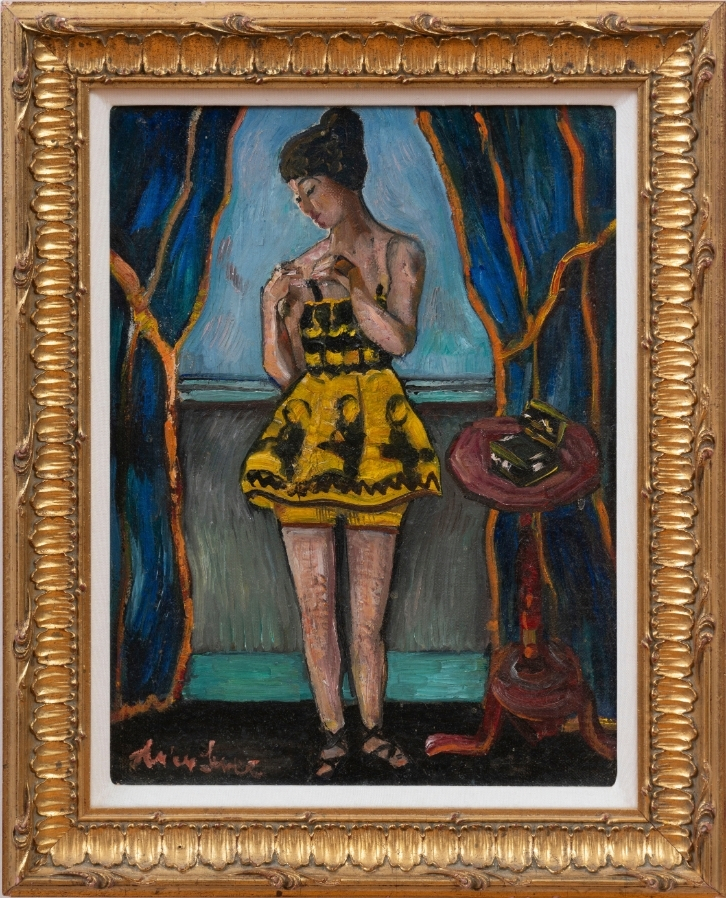
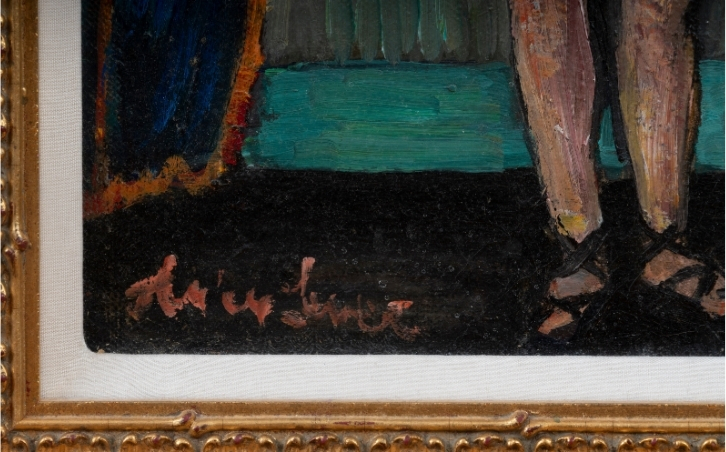
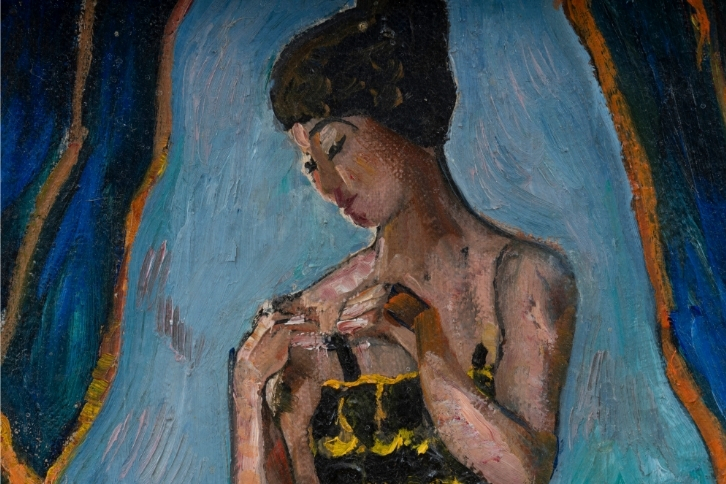
Woman Tying Strap by Hayley Lever (1876-1958), oil on cavnas, 16 1/4″ x 12 1/4″, signed lower left.
Richard Hayley Lever once boasted that “Art is the recreation of mood in line, form, and color. If I were confined to my own backyard for the rest of my life, I’d still have more pictures in my mind than I would have time to paint”. This excitement and holistic passion is effectively preserved in each of his artworks.
The Australian-American artist studied under James Ashton at Prince Alfred College before moving to St. Ives, a port town in England, to advance his artistic career. There, Lever shared a studio with famed marine painter Frederick Judd Waugh and similarly developed a distinct impressionistic style. Inspired by Van Gogh, Lever frequently employed impasto to create three-dimensional texture, a technique that breathed life into his landscapes and became a hallmark of his style. Lever’s stint in St. Ives additionally established the foundation for his career as a marine artist, dedicating several series to depictions of boats and other nautical subjects.
In 1912, Lever moved to New York City, following the advice of his friend and fellow artist Ernest Lawson. There, Lever made a name for himself beyond that of a skilled marine artist as he mastered both city and more provincial New England landscapes. He taught classes at the Art Students League of New York and eventually established a studio in Gloucester, Massachusetts. Prior to his death in 1958, Lever developed arthritis which hindered his ability to paint. Despite this impairment, his legacy immortalizes him as a pioneer in American seascapes and beyond. This collection includes highlights of his still lifes, genre studies (see Woman Tying Strap), harborscapes (see Sailboats in Carceneau), coastal scenes (see Massachusetts Coast), and ventures abroad (see Paris).

“To state upfront, I haven’t purchased anything from this shop so I don’t know how the prices compare. However, as a pedestrian always fascinated by this place, I enjoyed exploring two floors of antiques and art from around the world. The owner was kind enough to tell me the story behind a stained glass piece that belonged to George Washington’s family. It’s like getting up close to items in a museum!”
What a great find in Georgetown! Grace was an excellent tour guide and Peter is an absolute gem, will definitely be back! Highly recommend!
“L'Enfant Gallery is a haven of beauty and discovery! I often swing by just to walk around and bask in the incredible array of treasures!! I love the sheer variety and diversity it offers. I love hearing the stories behind each piece and embarking in an artistic time-travel of sorts! I love the staff, who are wonderful and so knowledgeable! And the events are great too! From fascinating lectures to more participatory proposals like a candle-lit yoga class! I always learn a lot and meet very interesting people! one of my top places in Georgetown and DC!!!”
“I have been a patron of L’Enfant Gallery since they hosted my wedding in 1985! As a resident of Georgetown for years, I have a long standing relationship with the gallery as a legacy Georgetown institution and Peter Colasante as an aficionado of all things art, neighbor and community pillar. In recent years L’Enfant Gallery has become more active in local events and is now an anchor in the Washington DC community arts festival (Art All Night). I have been fortunate to be able to attend some spectacular events at the gallery; a masquerade soirée, which was a sophisticated evening of intrigue where we chatted and sipped among the masters in disguise, slipping down the rabbit hole and dancing with DJs as the sky went from dark to light. A “dinner in the window”, hosted by L’Enfant Gallery showed them as a strong partner of Georgetown Mainstreet, supporting local restaurants in a one of a kind setting. Recently I attended a spelling-binding wedding celebration spanning the three floors of the gallery with cocktails, music and an interactive dance performance that led the way to the second floor which had been transformed into an intimate formal dining experience for over 50 people, prevailing F Scott’s panache for all the finer things… It is worth watching what is happening there when you are in town.”
“We found this spectacular gallery over 20 years ago and have acquired paintings, antique lights, furniture, and figurines from around the world there. The range and quality of the offerings on its several floors are stunning. Peter Colasante, the owner, has encyclopedic knowledge and is patient in explaining matters and answering your questions. It is the best gallery in D.C. Its reputation and longevity assure that you will find treasures and pieces not found elsewhere. We recently attended a gallery evening of music and song, with performances by singers, artists, and a magician.”
“I have gotten to know L’Enfant Gallery as an essential fixture in our Georgetown small business community. Peter, the owner, cares deeply about creating a safe and welcoming space, not only to shop for a diverse array of art and antiques, but also for artists to create within the gallery. I attended an incredible woman-led panel conversation “Art as Resistance” for the opening of their Wall of Women exhibition. I have also enjoyed how the gallery has used their storefront window as a living stage during Art All Night, Fall Market, and more- welcoming artists to create and perform. I had the pleasure of hosting a Dinner in the Window at the gallery to highlight our restaurant community in Georgetown. L’Enfant is a true partner for the arts and I would recommend engaging with them more, whether it is hosting an event, enjoying their diverse programming, or shopping their collection.”
"I've been shopping at L'Enfant Gallery since before opening my design firm in 1997. They occupy a rarefied space as purveyors of the finest antiques."