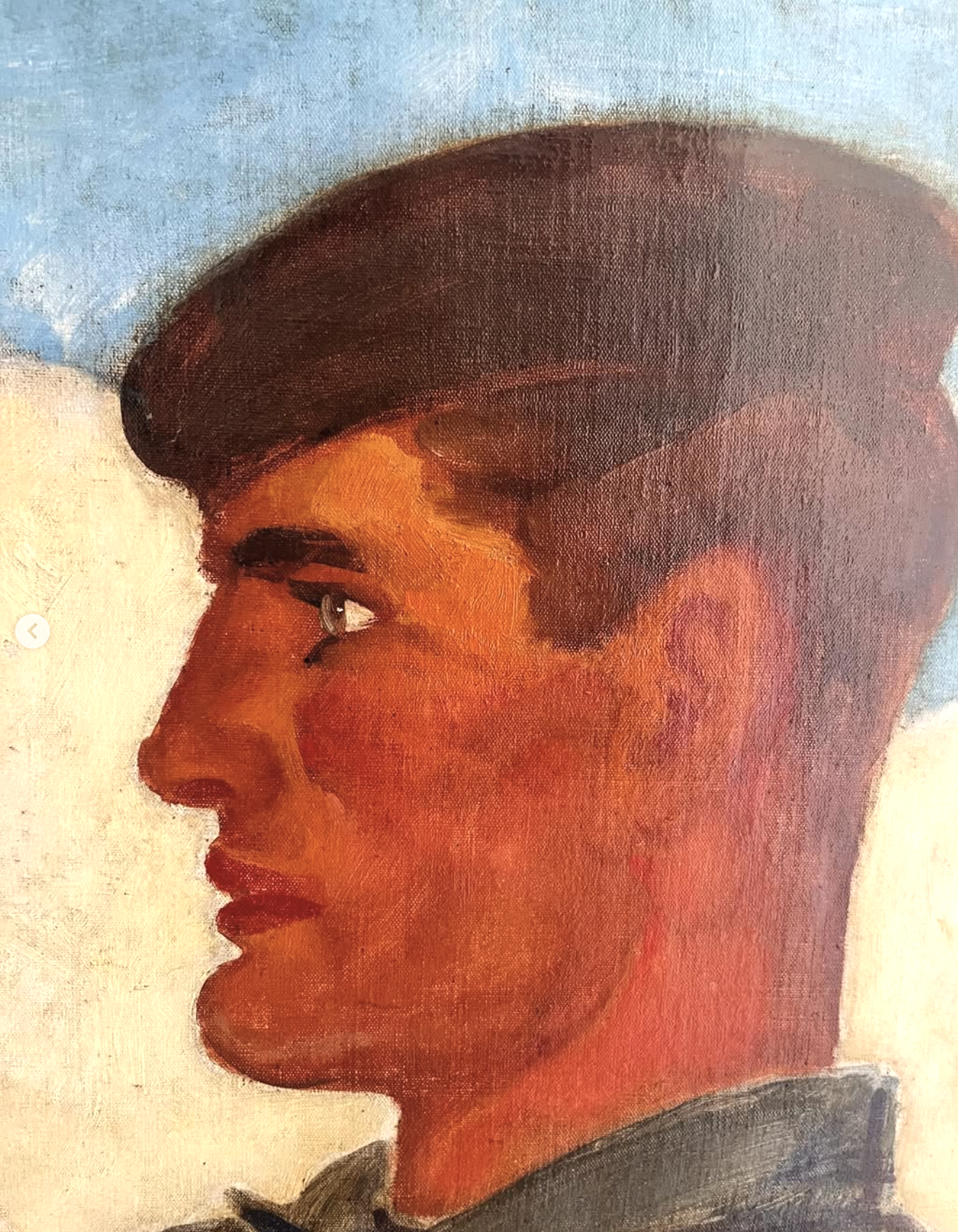
This, originally framed, unsigned, 47” x 37” oil on canvas, was painted circa 1992 by Claggett Wilson, known for his watercolors of exploding shells and mad-eyed soldiers. In a 2017 New York Times article, Holland Cotter depicts Wilson as both “an artist and a victim of chemical warfare who suffered from post-traumatic stress, but pulled himself out of it by painting the battlefield horrors he’d lived through.”
Claggett Wilson (1887–1952) was born in Washington, D.C. The artist attended Princeton University, the Art Students League, New York City, and then the Julian Academy, Paris (1909–1912), where he studied with Richard E. Miller, F. Luis Mora, and Jean-Paul Laurens. After becoming a member of the Société des Artistes Indépendants in Paris, he returned to the U.S. in 1915 to instruct in the Fine Arts and Architecture departments of Columbia University and Teachers’ College, NYC.
During the Great War, he served in France and Germany with the 5th Regiment of the United States Marines. On June 16, 1917, he was evacuated to the hospital at Dijon. Returning to the front in August 1918, he was made aide-de-camp to a brigadier general. During the winter of 1918–1919, he was part of the Army of Occupation in Germany until his discharge later that year. In 1937, he lectured on “Color and Design” at the Metropolitan Museum of Art in New York.
In An Artist’s View of WWI and How to Preserve His Portraits of War, paper conservator Kate Maynor and military historian Ben Brands turn to Wilson’s watercolors—strokes shaped by the searing memory of life as a Marine.
If you are interested in discussing the purchase of this item, please suggest your availability (EST) for a phone call with Peter Colasante via our contact page.