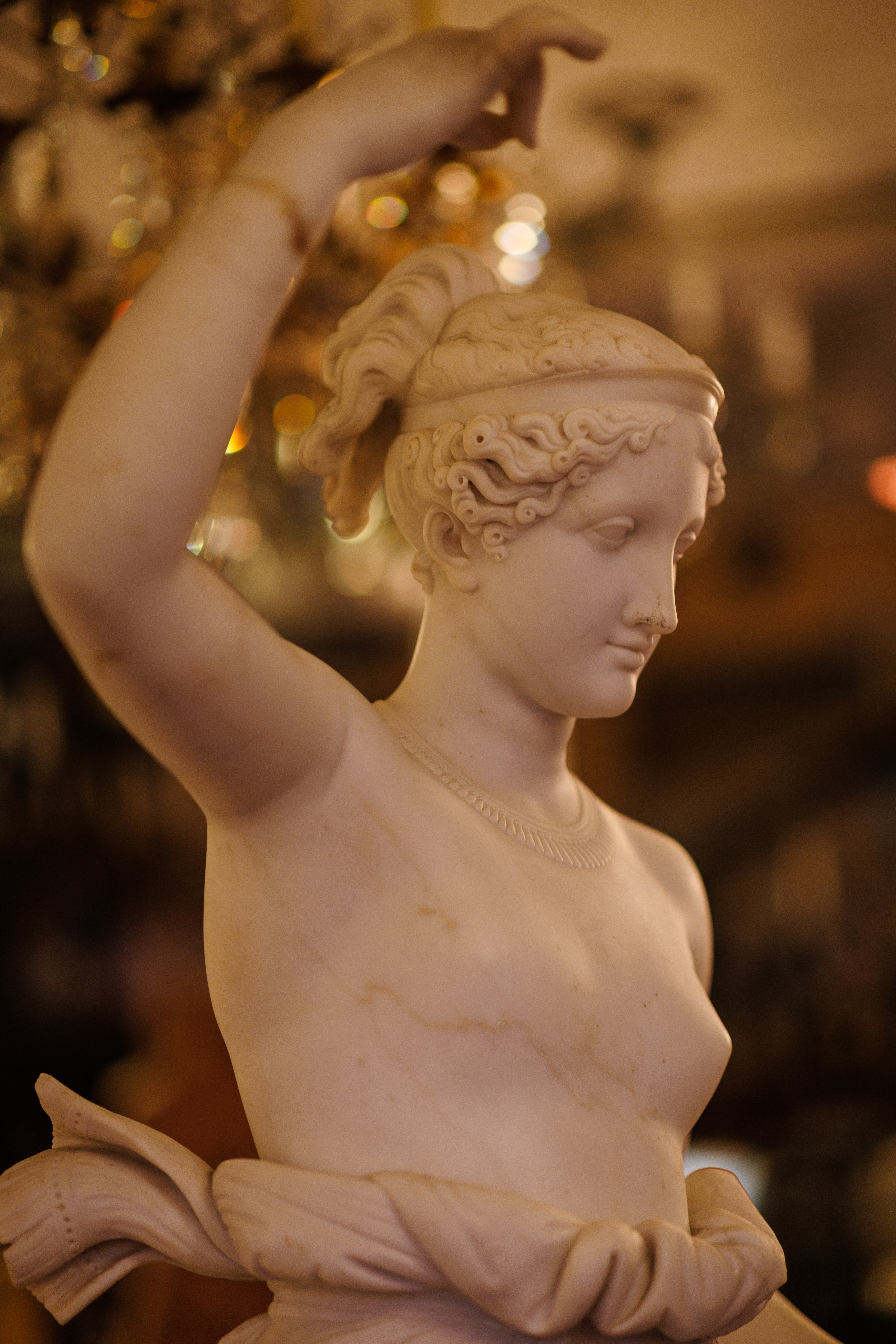
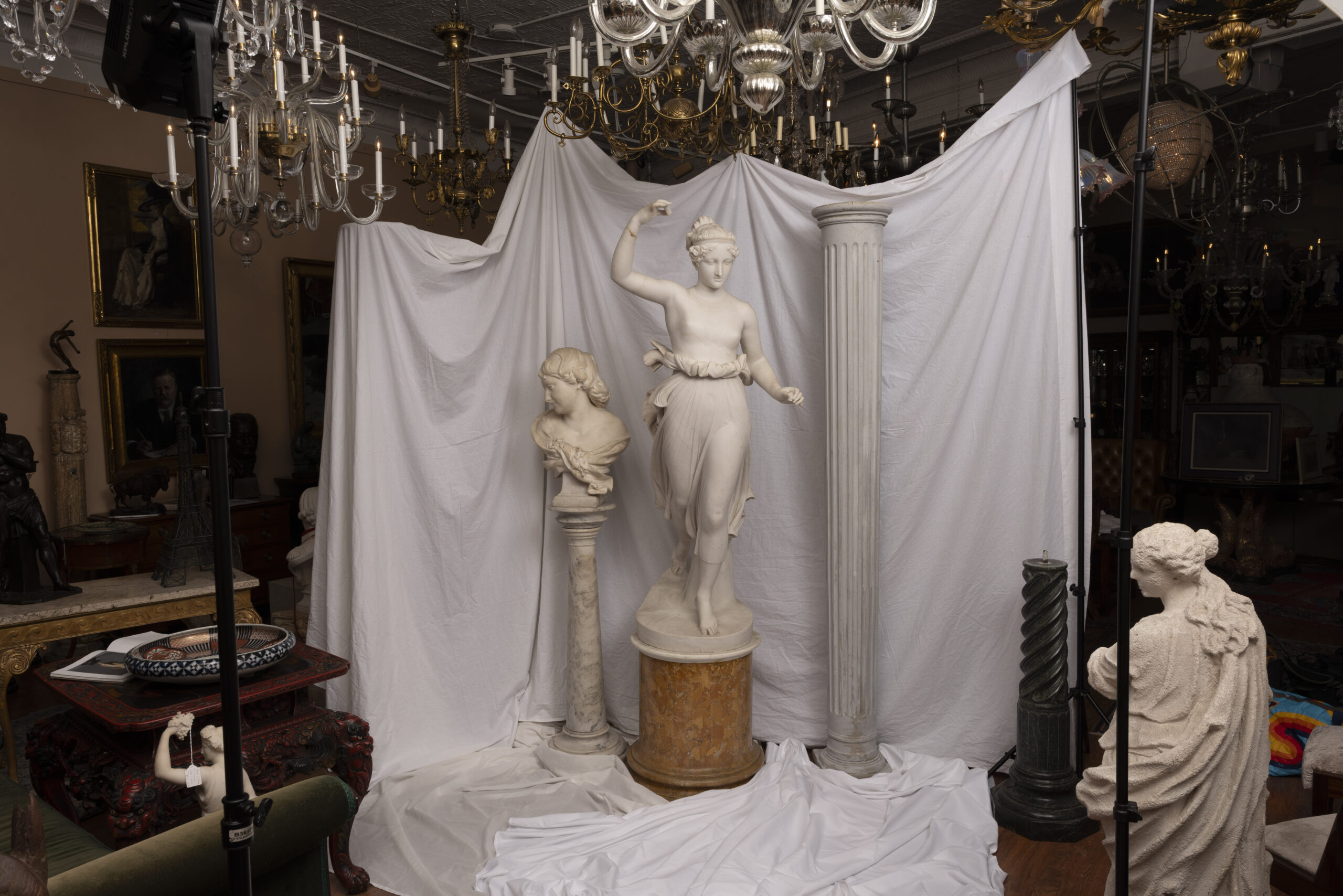
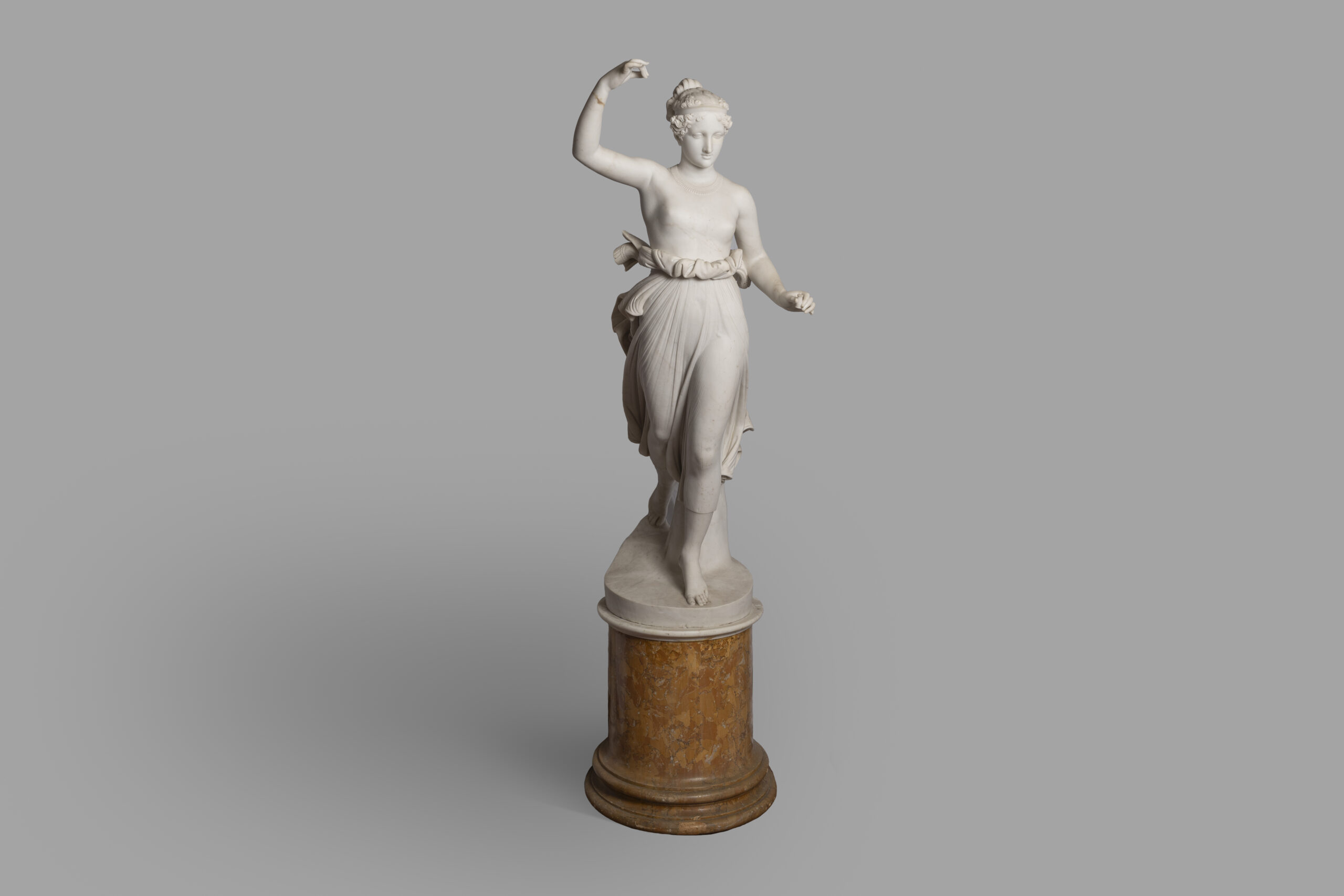
The goddess produces an offering: her back foot is raised in approach while her right arm is raised in presentation of a phantom oinochoe. Her left arm is similarly positioned holding a kylix, this time next to the billowing chiton fastened around her waist at her side. The fabric clings to her idealized form, trailing behind her as she seemingly walks towards you. Her bare chest is crowned by a decadent marble necklace, all of which supports her head perfected with classical conventions. Her Greek curls are tied back, held by a simple diadem, so that you may meet her kind yet commanding gaze. A smile tugs at her lips as her blank eyes greet the viewer with generosity and grace. As she stands as the provider of ambrosia and nectar to the gods, maintaining the pantheon’s eternal youth, the viewer fills the role of a deity receiving such gifts. Hebe, the goddess of youth, is appropriately flawless– with the minimal exception of the band of discoloration around her raised right wrist.
As an adolescent in 1965, Peter Colasante, founder of L’Enfant Gallery, walked to his high school in New York City. On his route, where he was most likely pondering his aspirations for the stage or chemistry homework, his gaze was always caught by a figure in a gallery window. More specifically, Hebe seemed to be looking directly at him. At this point, Peter had no intention of starting an art gallery, but he couldn’t help but find himself captivated by the delicate discolored wrist of the goddess in the window. After this brief pause, he went about his day.
The year is 2007 and Peter, now 59, finds himself in Old San Juan running his own art gallery. One day, back when he would “do horrible things to his body like exercise”, Peter went for a run in his modest neighborhood to look at the houses and the lawns and catch glimpses of the people who lived there. One glimpse, however, made Peter fall to the ground in shock. There, in the window, in this random house in this random neighborhood in random Old San Juan, was Hebe, his Hebe. Her stance was instantly recognizable, but it was the delicate discoloration on her raised right wrist that confirmed her identity. Peter, once he regrouped, knocked on the door until someone answered and insisted he buy that piece, pleading that money was no object. After weeks of negotiating, and years of paying off the owner, Hebe was his; a piece that reminded him of his humble beginnings and why he got into the art business in the first place, a piece that also just happened to be a Canova.
If you are interested in discussing the purchase of this item, please suggest your availability (EST) for a phone call with Peter Colasante via our contact page.